The Dancing Faun
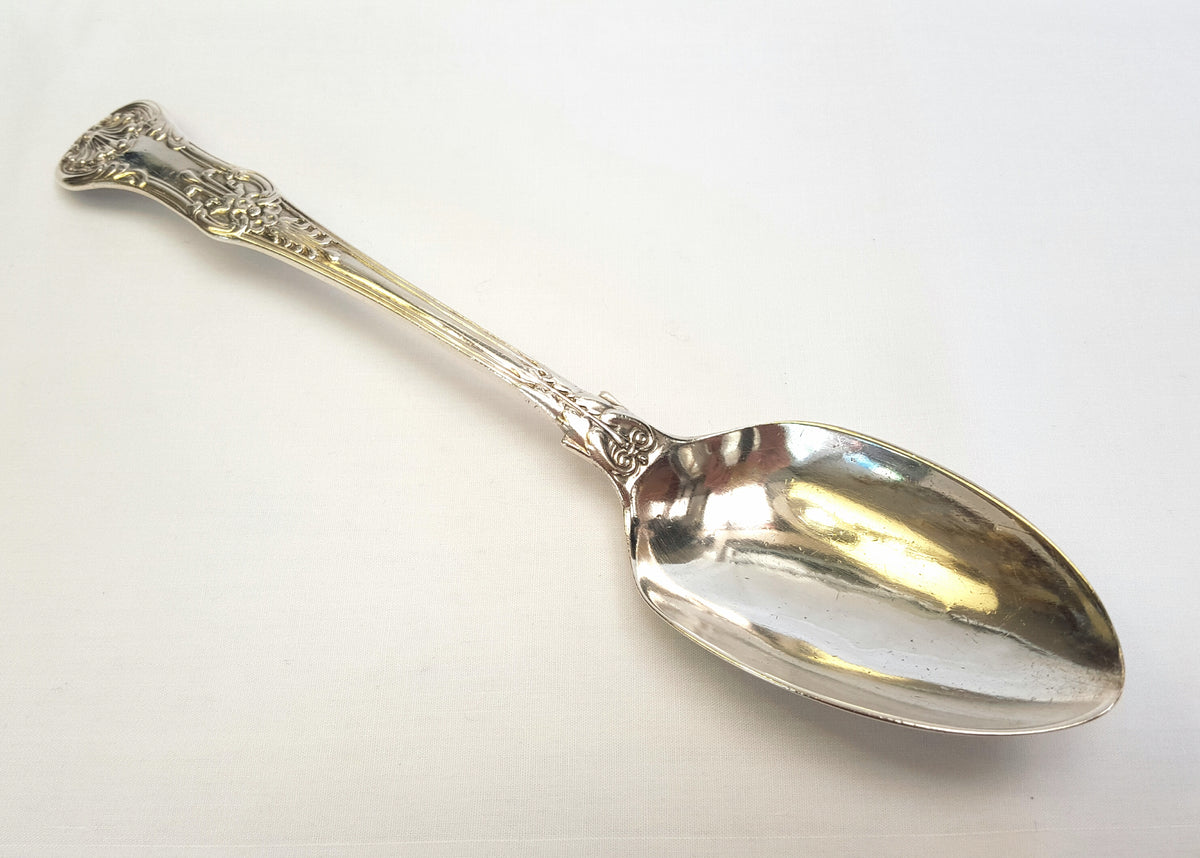
Sterling Silver | King's Pattern Serving Spoon | London 1836 | William IV
Sterling Silver | King's Pattern Serving Spoon | London 1836 | William IV
Couldn't load pickup availability
Sterling Silver | King's Pattern Serving Spoon | London 1836 | William IV
A silver spoon hallmarked in 1836 was made in the last full year of William IV's reign — one year before a young queen arrived and gave her name to everything that followed.
The King's pattern is among the oldest and most enduring designs in English silver flatware, introduced in the early nineteenth century and remaining in continuous production to the present day. Its defining features — the pronounced shell at the bowl junction, the scrolled shoulders, the floral and foliate detail at the terminal — drew on the decorative vocabulary of the Regency period and translated it into a flatware pattern of considerable robustness and visual authority. By the 1830s the King's pattern had become the standard of the well-appointed English dining table, produced by the leading London silversmiths in full services and in individual serving pieces of every type. A serving spoon of this scale, hallmarked London 1836, represents the pattern at its most assured and most useful — a piece made for formal dining that has survived nearly two centuries of use and remains entirely fit for the purpose for which it was made. The London hallmarks are fully struck and include the lion passant, the leopard's head, the sovereign's head duty mark and the date letter for 1836, with the maker's mark present though not currently identified from available records.
The spoon is of generous serving proportions, the bowl broad and oval with a shell motif at the junction with the stem. The stem carries the characteristic King's pattern moulding throughout its length — the raised central rib, the foliate detail at the shoulders, and the scrolled terminal with shell and floral decoration at the finial end. Both faces of the spoon are decorated in the manner of the pattern, with the reverse of the bowl carrying the shell drop and the reverse of the handle showing the ribbed stem and foliate detail. The silver is bright and even, with the warm surface character of well-used and well-maintained Victorian-period sterling.
Light surface wear consistent with nearly two centuries of use and polishing is present. There are no dents, splits, repairs or erasures to the hallmarks. The piece is in excellent antique condition.
Key Details
- Material: Sterling silver
- Pattern: King's pattern
- Form: Large serving spoon
- Assay Office: London
- Date: 1836
- Period: William IV
- Maker: Unidentified — maker's mark present but not confirmed from available records
- Dimensions: 23.2cm L × 5cm W
- Weight: 107g
- Condition: Excellent antique condition — light age-consistent surface wear; no repairs
Silver that has been polished for nearly two hundred years carries in its surface a record of every hand that kept it bright — which is not a metaphor but a physical fact.
Share