English Porcelain | Part Tea Service | Green Ground with Gilt Acanthus and Hand-Painted Flower Reserves | Pattern 239 | c.1820–1840 | 13 Pieces
Two hundred years after it was first laid on a table, this service still holds together — which says something about both the making and the keeping.
The production of fine English porcelain tea services reached a peak of technical and decorative ambition during the Regency and early Victorian periods. The Staffordshire potteries — including makers such as Ridgway, Minton, Spode, and Coalport — competed in producing wares defined by rich ground colours, elaborate gilt ornament, and individually hand-painted reserves.
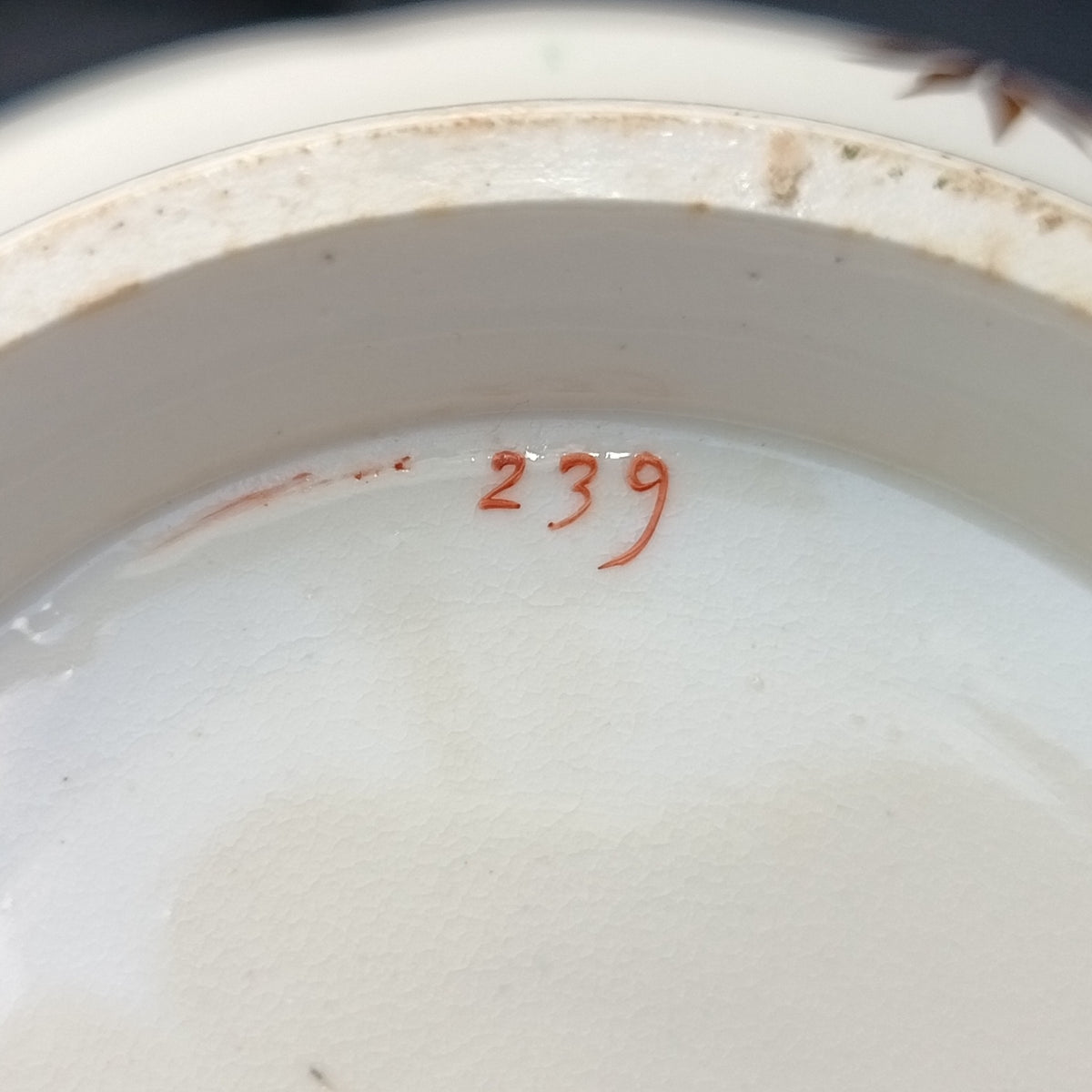
This service carries only the hand-painted pattern number 239, consistent with early numbering systems used from the 1820s onwards. The absence of a factory mark is typical of the period. The quality of the enamel painting, the density and confidence of the gilt acanthus work, and the overall decorative coherence point to production by one of the principal Staffordshire factories, working firmly within the Regency decorative tradition.
The service comprises thirteen pieces: a teapot with cover, a milk jug, a large open bowl, four teacups with four saucers, and two demitasse cups. Each piece follows a unified decorative scheme: a vivid apple-green ground segmented by shaped white cartouche reserves, each framed with gilt acanthus scrollwork and containing an individually hand-painted floral spray.
The flowers vary across the service — including roses, blue daisy-form blooms, and mixed botanical studies — each rendered with the slight variation and softness characteristic of hand painting. Between the reserves, the green ground is enlivened with freely drawn gilt foliage. Gilt lines accent the rims and feet throughout.
The teapot is of lobed ovoid form with a scrolled spout, loop handle, and a rose-form finial to the domed lid. The milk jug is of generous helmet form. The open bowl is simply finished, allowing the decoration to carry the piece. The teacups are rounded and comfortable in the hand, while the demitasse cups are more upright, consistent with early 19th-century coffee wares.
The service shows honest age-related wear consistent with its period. The teapot has been professionally restored: the spout and lid carry white material restorations, visible on close inspection. One teacup has a stable through crack to the base. Gilding shows light wear across high-contact areas, and there is minor age-related staining to some pieces. There are no additional structural damages noted.
Collector Appeal
- Early 19th-century Regency period porcelain
- Classic green ground with gilt acanthus — a highly recognisable and desirable decorative scheme
- Hand-painted floral reserves, each slightly varied
- Unmarked but high-quality Staffordshire production, likely from a leading factory
- Inclusion of both teacups and demitasse cups, reflecting transitional tea/coffee service use
- Increasing scarcity of complete or near-complete services from this period
Key Details
- Origin: English, Staffordshire
- Attribution: Principal Staffordshire manufacturer, possibly Ridgway or Minton
- Pattern number: 239 (hand-painted)
- Period: c.1820–1840
- Material: Porcelain
- Pieces: 13
- Total weight: 2,379 g
- Dimensions: Available on request
- Condition: Good antique condition; professional restoration to teapot; one cracked cup; some gilt wear and age-related staining
What survives a table for two hundred years is not merely the porcelain — it is the judgement of every person who picked it up and chose to put it down carefully.