The Dancing Faun Antiques
Pair of Hand-Painted Orientalist Pottery Busts on Pedestals, 21 cm
Pair of Hand-Painted Orientalist Pottery Busts on Pedestals, 21 cm
Couldn't load pickup availability
How we describe condition and attribution →
Pair of Hand-Painted Orientalist Pottery Busts on Pedestals, 21 cm
A man in a tasselled fez and a woman in a wrapped turban, both looking down as though sharing a thought neither has yet put into words.
Through the nineteenth century, European painters, writers and manufacturers drew constantly on the dress and imagery of the Ottoman world, from Greece and the Balkans to North Africa. The fashion, now called Orientalism, reached ordinary homes through prints, textiles and decorative ceramics. Busts and figures in fezzes, turbans and embroidered jackets were made in quantity for the mantelpiece and the cabinet. They were seldom portraits of real people. They offered an idea of somewhere far away, coloured and costumed for the parlour.
The man has long, waved brown hair, a full beard and a tall mauve fez, with a blue-grey tassel falling at the back. He wears a pale turquoise shirt under a rose waistcoat, its front edges raised in ochre braid in the manner of Greek and Albanian dress. His companion wears a rose cap wrapped in a cream turban, gold-painted earrings, a brown beaded necklace, and a blue bodice edged in cream and closed with three rose fastenings. Her head turns gently towards him. The colours are soft and washed, gathering darker in the folds of the clothing and the moulded strands of hair. The backs are left largely plain, as was usual for pieces made to be seen from the front. Each bust stands on a waisted pedestal with canted corners, in a near-black glaze that shows deep blue where it catches the light.
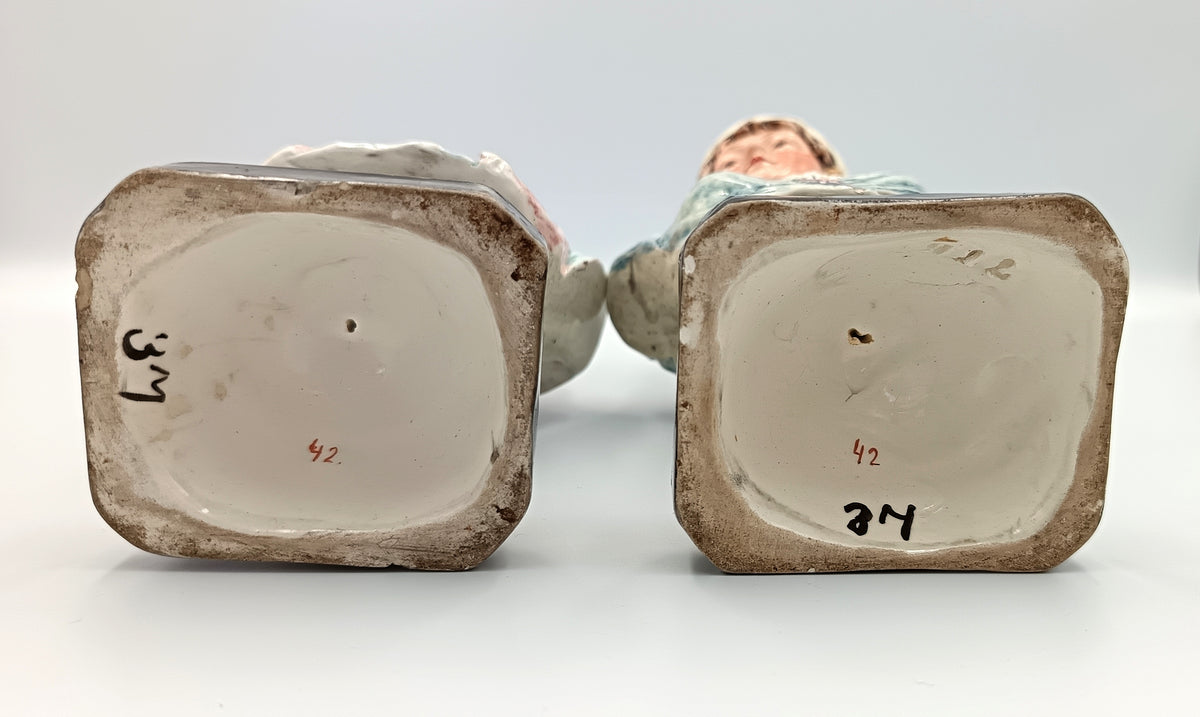
Underneath, the busts are impressed 775 and 776. These consecutive model numbers suggest the two were designed as companions. Each also carries a red-painted 42 and a similar handwritten black mark, further supporting their association as companion pieces. Numbering of this kind is typical of European factory production in the later nineteenth and early twentieth centuries. The maker has not been identified, and the pair has not been firmly dated.
The man has two small chips: one to the tip of the nose, and one on the lower back edge at the right, below the hair, which exposes the ceramic body and cannot be seen from the front. The woman has one small chip on the lower front edge of the bodice, just above the pedestal, with a small loss of blue glaze. All three are shown in the photographs. Apart from these three small chips, the busts present in very good overall condition. The black pedestals are rubbed, especially along the edges, and the painted and glazed surfaces show light age-related wear, along with small specks and irregularities from manufacture. No restoration is apparent from visual examination; the pieces have not been examined under ultraviolet light.
Key Details
- Subject: a man in a fez and a woman in a turban, in Orientalist costume
- Maker: unidentified, European
- Period: late 19th or early 20th century in style; date not confirmed
- Material: hand-painted glazed earthenware
- Marks: impressed 775 and 776; red-painted 42 and a handwritten black mark on each
- Height: 21 cm each
- Condition: good; very good apart from three small chips, as described above
- Sold as a pair
- Buyer profile: collectors of decorative European ceramics and Orientalist subjects, and anyone with a mantelpiece, bookcase or cabinet that suits a pair
Collector Appeal
Consecutive model numbers and similar painted marks are good evidence that these two were made and decorated to stand together, which is not true of every pair found today. They are modest in size and expressive in their modelling. They also leave room for research: the numbers give a starting point for anyone who wants to trace the maker.
Made to share a mantelpiece, and still keeping each other company.
Share